

Senegal’s human rights defenders fear a draft bill on political finances


Activists worry that their foreign funding will be banned; Oxfam tries to avoid anti-LGBT blowback
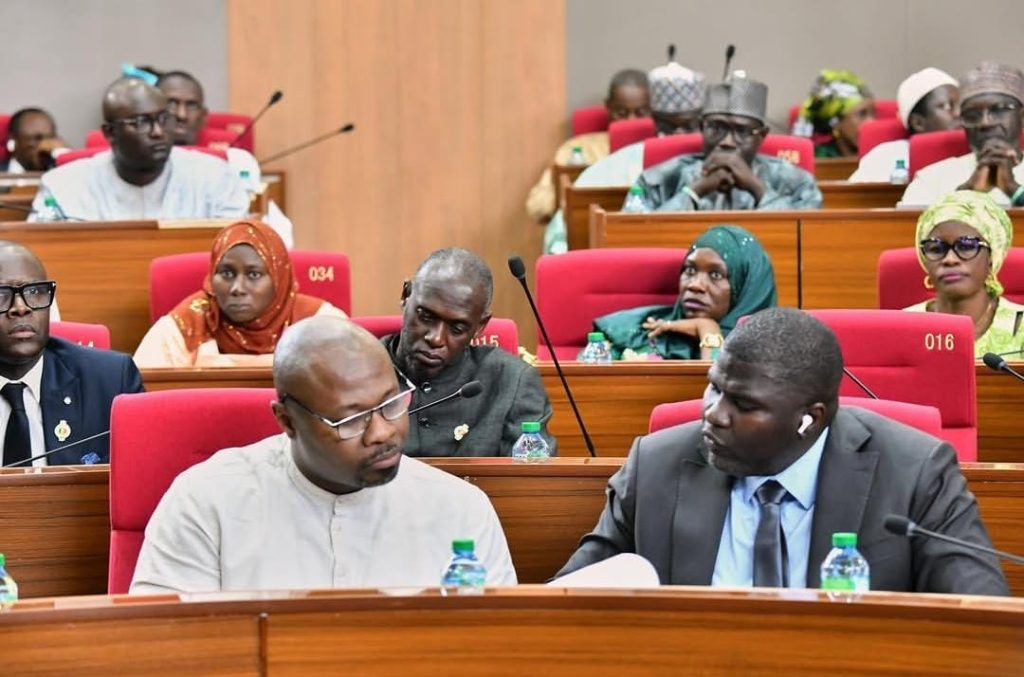
LGBT+ advocates in Senegal are keeping a wary eye on legislators who are working on a draft bill that would revise regulation of political parties, which are barred from receiving funding from non-Senegalese sources abroad. The activists’ fear is that the ban could be extended to cover civil society organisations, including human rights advocacy groups.
The precedent of criminalising the funding of activities in support of LGBT+ people
The legislative activity comes against a backdrop in Senegal where the funding of activities in support of the LGBT+ community – or de facto linked to it – is a crime punishable by up to seven years in prison.
The draft bill comes a year after Ousmane Sonko, the former prime minister who is now Speaker of the National Assemby, told the ruling Pastef party’s National Council that he wanted to ban foreign funding of civil society organisations in Senegal.
From Sonko’s viewpoint, Africa suffers from a double standard: African civil society is heavily influenced by foreign donors, but European countries would categorically reject this type of interference.
Sonko maintains that foreign-funded associations exploit their status to exert political influence over the government and impose values that he considers “contrary to the democratic choices of the Senegalese people.”
Oxfam, the international anti-poverty charity, has been dragged into debate, with some people accusing it of financing LGBT+ activities in Senegal. Among them is Aliou Sané, the leader of the Y’En a Marre Collective, who also acknowledged that his movement benefited from Oxfam’s financial support when he opposed Macky Sall’s 2024 bid for a third term as president despite the two-term limit set by the Senegal Constitution.
As the debate over foreign funding continues, Oxfam in Africa (OiA) has faced controversy over LGBTQ rights. OiA, which is one member of the Oxfam International coalition, drafted an internal guideline prohibiting its staff from discussing LGBTQ issues in order to maintain focus on anti-poverty work and to “avoid creating risks to LGBTQ communities, partners, and staff in Africa”. Those guidelines were retracted under criticism from Oxfam staff.
The New Humanitarian reported: “Numerous Oxfam entities openly support LGBTQ rights. Oxfam South Africa, which is separate from OiA, seeks to end discrimination on the basis of sexual orientation and has recently posted pro-LGBTQ content on social media. Oxfam in Ghana, which is now part of OiA, published a social media post celebrating movements working to end violence against trans and non-binary people in late 2021, before OiA was created.”
That dispute erupted in the midst of a wave of anti-LGBT legislation in Western Africa, including severe anti-homosexuality laws in Mali, Niger, and Burkina Faso and passage of a harsh bill in Ghana that would criminalize “identifying” as gay and would make “promoting” LGBTQ activities punishable by up to 10 years in prison.” It has not yet been signed into law.
Senegal’s contribution to that anti-LGBT wave was the doubling of prison terms for same-sex intimacy — to 10 years — and criminalizing funding, “promotion” and “glorification” of homosexuality, with penalties of up to seven years’ imprisonment, 10 years’ deprivation of civil rights and fines of 5 million CFA francs (7,622 euros or US $8,713) in a country where the median wage was recently calculated at 132 euros. [See the text of the laws below.]
A focus on bringing civil society organisations under greater control
Two knowledgeable observers of political life in Senegal agreed to answer questions from Erasing 76 Crimes to provide insight into the latest talk is all about transparency and improving ethical standards in public life in Senegal. They are Sadio (pseudonym) – a Dakar-based observer of the intricacies of Senegalese political life – and Diawara (pseudonym), a pro-Sonko Senegalese man living in Marseille, France.
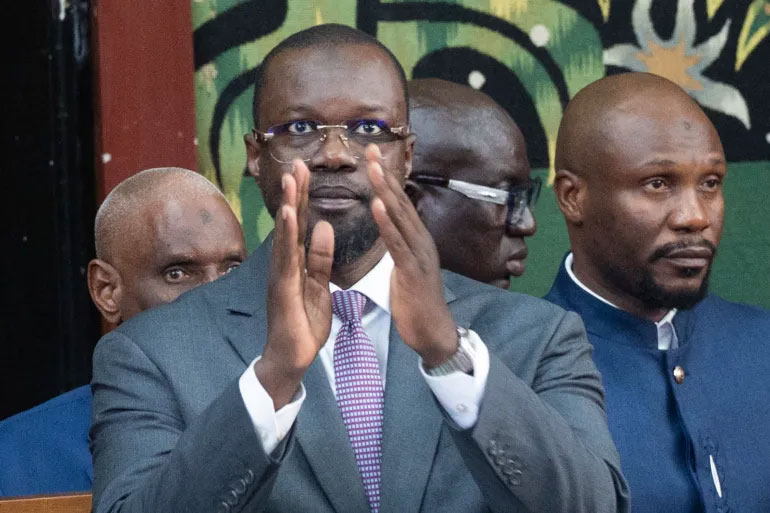
At this stage, the aim of Sonko and his supporters is to draft a future law based on the following proposals:
- Introduction of public funding for political activities
- Audit of finances by the Court of Auditors
- Stronger regulation of the formation, organisation and dissolution of parties
- Mandatory financial transparency (certified reports and statements)
- Conditions for formation including 15,000 sponsors spread across several regions
- Ban on foreign funding.
However, some, such as Sadio agree that greater integrity is needed to put an end to the practice of candidates receiving hidden funding, whilst expressing concern regarding civil society organisations: Sadio said:
“There is talk of political party funding and the ethical reform of public life, with the aim of opening up a broader debate focused primarily on President Bassirou Diomaye Faye. His critics within Pastef (the ruling party) are seeking to weaken his presidential powers, particularly since he dismissed Ousmane Sonko from his post as Prime Minister. With Sonko now President of the National Assembly, the aim is to make the regime more parliamentary by shifting the centre of gravity for decision-making and oversight to the unicameral assembly and the Court of Auditors.”
Nevertheless, Sadio states, within civil society everyone knows that, having targeted the funding of political parties, the authorities have now set their sights on non-governmental organisations; indeed, Ousmane Sonko had already alluded to this last year, as he no longer wishes to see development aid funds being used for politicised and partisan activities by organisations in the public sphere.
“In the name of combating foreign interference, there is a significant risk that civil society organisations will lose all autonomy from political power, even though many reforms are moving in the right direction.” he said.
Diawara added, “Senegal is sovereign over its own territory, and those states or international activists who pass judgement on the actions of the Senegalese authorities – even if only through the NGOs they fund – are lacking in diplomatic courtesy”. However, he does not explicitly call for an end to international funding for civil society organisations.
Relevant passages of existing Senegalese laws
Article 319 (extract – provisions relating to the glorification of an unnatural act)

‘The promotion of an unnatural act shall be deemed to be any public representation, whether by speech, writing, image, gesture, sound or by any other means whatsoever, intended to promote homosexuality, bisexuality, transsexuality, bestiality, necrophilia or any other similar practice.
Any person who, by any of the means set out in Article 248** of this Code, advocate an act referred to in the first paragraph of this Article, shall be liable to imprisonment for a term of 3 to 7 years and a fine of 500,000 to 5,000,000 CFA francs. Any person who has deliberately financed or supported, by any means whatsoever, a person, a group or an activity with a view to promoting or glorifying homosexuality, bisexuality, transsexuality, bestiality, necrophilia or any other similar practice, shall be liable to the penalties provided for in the preceding paragraph.
Persons found guilty of the offences set out in the preceding paragraphs of this article shall be deprived of the rights listed in Article 34*** of this Code for a period of 10 years, commencing on the day on which the principal sentences become final.”
Article 248 of the Senegalese Criminal Code (means of public dissemination)
‘The following are considered to be means of public dissemination: radio broadcasting, television, cinema, the press, billposting, exhibitions, the distribution of written material or images of any kind, speeches, songs, shouts or threats uttered in public places or at public gatherings, and, generally, any technical process intended to reach the public.’
Article 34 of the Senegalese Criminal Code (prohibition of certain rights)
“Courts hearing criminal cases may, in certain cases, prohibit, in whole or in part, the exercise of the following civic, civil and family rights: the right to vote; the right to stand for election; the right to be called up or appointed to serve as a juror or in other public offices, or to hold posts in the civil service, or to perform such duties or posts; the right to carry and possess weapons; the right to vote and have a say in family matters; the right to act as a guardian, substitute guardian or curator; the right to act as an expert or witness, except to provide simple information in court.”

