

Left-wing French politicians dance around Senegal’s anti-gay repression


In France, the Senegal diaspora of 200,000+ people has potential political clout.
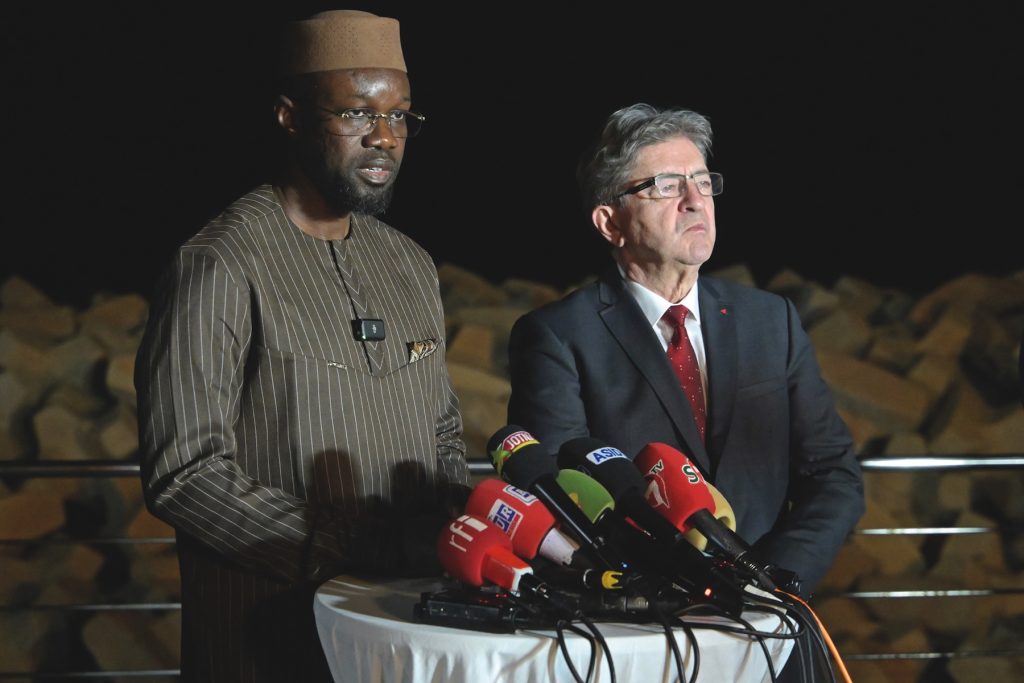
France’s left-wing minority party La France Insoumise (LFI) has been a strong supporter of LGBT rights in general and the anti-colonialism of Ousmane Sonko’s Pastef party in Senegal. But strains developed in the LFI-Pastef alliance after Pastef came to power in 2024 elections and pushed through a harsh anti-gay law in March 2026 that led to nearly 100 arrests. Protesting those arrests was something that LFI leaders had difficulty doing.
Reporter Nicolas Scheffer tells the story in the French LGBTQ magazine Tetu. An English trnaslation of his article is below:
State-sponsored homophobia in Senegal: LFI’s dance with Pastef
Jean-Luc Mélenchon has publicly expressed his disagreement with the homophobic program of the ruling party in Senegal. But since the party has taken action [launching a nationwide anti-gay crackdown], his party, La France Insoumise, has become much more discreet.
In May 2024, speaking to students gathered in Dakar, Jean-Luc Mélenchon openly expressed his disagreement with Ousmane Sonko. The [then] Senegalese Prime Minister had just denounced the prominence given to LGBT issues in the programs of international institutions, which he claimed were sometimes treated as conditions for financial partnerships.
The leader of La France Insoumise (LFI) responded directly: “I am the first French legislator to have introduced a bill concerning the possibility of same-sex marriage. […] I stand by the political position I have chosen, and I will not try to impose it on you.”
Two years later, the disagreement took on a new dimension. The African Patriots of Senegal for Work, Ethics, and Fraternity (Pastef), Ousmane Sonko’s party, came to power in 2024 with the election of Bassirou Diomaye Faye as president.
He then moved from words to action. In March 2026, the Senegalese Parliament adopted a law doubling the prison sentences for homosexuality, increasing them from five to ten years.
“This is the first law I myself introduced in the National Assembly,” Ousmane Sonko proudly stated.
While arrests multiplied across the country, putting LGBT organizations on high alert from Dakar to Paris, the Mélenchon movement, usually quick to denounce human rights abuses, remained remarkably silent.
On May 19, MEP Manon Aubry finally expressed her “profound disagreement with this persecution” on X. It was this obvious discomfort that [the LGBTQ magazine] têtu· highlighted in its editorial in the previous issue, dedicated to our brothers and sisters in Senegal. Andy Kerbrat, the left-wing MP for La France Insoumise, despite his involvement in these issues, reacted angrily, calling têtu· a “right-wing gay newspaper.” How far is the movement willing to go to justify this alliance?
For several years, La France Insoumise (LFI) has maintained close ties with the sovereignist and pan-Africanist party, founded in 2014 by Ousmane Sonko. They share a discourse of breaking with the established political order and a critique of the power dynamics inherited from colonialism.
Their rapprochement materialized during the Senegalese presidential election. Facing Macky Sall, in power since 2012 and accused of authoritarian drift, the duo of Ousmane Sonko and Bassirou Diomaye Faye embodied change and appealed to young people. A year before the election, amidst a climate of repression of the opposition and waves of arrests, Ousmane Sonko was imprisoned after being convicted of “corrupting youth” in a case where he was accused of rape.
Jean-Luc Mélenchon then came to his defense.
“In Senegal, opposition leader Ousmane Sonko is facing disqualification from holding office. This rightly alarms friends of this country, long considered a model of democracy,” he wrote on X. “In a context where France was accused by the Senegalese people of supporting Macky Sall, we wanted to embody a voice defending democratic renewal,” explains MP Arnaud Le Gall, who advises the radical left leader on African issues, to Têtu.
Ousmane Sonko’s homophobia, however, is not a recent discovery since he came to power. Since the early 2020s, the future Prime Minister [now Speaker of the National Assembly] has not hesitated to fan the flames in a country where anti-LGBT demonstrations, called for by Islamist organizations, are on the rise.
“The law criminalizing homosexuality will be one of the first I will push through,” he tweeted as early as 2022. [Editor’s note: Senegal already had an anti-homosexuality law at that point. Under a law passed in 1965, homosexual acts were punishable by 1 to 5 years in prison.]
Arnaud Le Gall, however, refutes any suggestion of wavering in his party’s diplomacy:
“We supported democratic change, but at no point did we endorse the Pastef program. We were very clear on condemning homophobia in Senegal, and we did not formalize any alliance with Pastef,” he insists. The MP also points out that LFI refused to attend a congress of the ruling party in June. Very clear, really? In France, where a large Senegalese diaspora lives, several incidents reveal a far more uncomfortable position…

In Saint-Denis, the capital of the Seine-Saint-Denis department, led since March by the La France Insoumise (LFI) member Bally Bagayoko, the Socialist Mathieu Hanotin proposed to the city council on June 25th a “resolution of support from the city of Saint-Denis for LGBT+ people persecuted in Senegal and reaffirming the universality of human rights.” A symbolic initiative that, on the face of it, seemed to garner considerable consensus.
However, Diangou Traoré, the LFI deputy mayor in charge of community life, expressed concern that the text was aimed directly at the Senegalese diaspora: “We prefer to avoid any wording that could be interpreted as an attack on people who have close ties with the Senegalese people,” she argued into the microphone.
The debate, held at the end of the session, continued. Jimmy Markoum, a Communist member of the majority, denounced the “neo-colonial undertones” of the proposal. “To call into question, in such clear terms, the national sovereignty of a country that inherited colonial rule is illegitimate and counterproductive,” he argues. His solution: to drown out the homophobic repression in Senegal within a broader denunciation of the “global conservative wave.”
“Without saying that the problems exist only in Senegal, we must point out that this law is sending people to prison who weren’t going there before March!” replies Mathieu Hanotin.
Bally Bagayoko agrees with Jimmy Markoum on several of his remarks, which he considers “common sense,” and points out the “shortcomings” of the Socialist text. The motion is adopted, but the LFI (La France Insoumise) members abstained.
A few kilometers away, relations with Pastef are warm. In Sarcelles, in the Val-d’Oise region, the local branch of the Senegalese party is organizing a barbecue on June 20th, attended by Alioune Sall, Senegal’s Minister of Communication until last June, who previously lived in France.
A French elected official is also present: Carlos Martens Bilongo, a member of parliament for La France Insoumise (LFI). On social media, the two display their close relationship, addressing each other as “my friend, my brother.”
“The two have known each other for a long time,” says Arnaud Le Gall. And with good reason. Before the presidential election, Alioune Sall was tasked by Ousmane Sonko with mobilizing the Senegalese diaspora in France, estimated at between 200,000 and 300,000 people. The French branch of Pastef then boasted 10,000 current members and played a significant role in the political transition in Senegal.
Could this activist force be used in another campaign in the future? “Today, we haven’t planned to campaign for Jean-Luc Mélenchon, but if Pastef asked us to, we would,” admits Baba Diallo, head of the local party branch. This probably explains it.
