

How one nonbinary Haitian activist built community through micro-credit


Haitian experiment shows how micro-credit can foster inclusive development
International support for LGBT+ startup businesses has declined, but some novice LGBT+ entrepreneurs have accomplished more than was expected of them.
Rodneyson Bernardin, a non-binary activist living in Limbé, a small town in northern Haiti, shares what he experienced starting in 2021 at the intersection of issues relating to funding, micro-entrepreneurship, non-binary identity and rural life.
His observations are especially relevant at a time when international funding is on the decline and crisis hotspots are multiplying. Against a backdrop of soaring commodity prices that disproportionately affect the poorest populations, these social emergencies are particularly acute for LGBT+ people, who have increasingly been excluded from development aid projects since Donald Trump’s return to power in the United States.
This is our interview with Rodneyson Bernardin:
A project rooted in the economic and social reality of northern Haiti
Erasing 76 Crimes: What was your micro-business venture?
Rodneyson Bernardin: My plan was to set up a large food warehouse called “Masimadi Bazar,” to create a safe and welcoming place where LGBT+ people could shop and easily find food close to where they live (Editor’s note: “Masimadi” stands for Masisi and Madivine, meaning gay men and lesbians in Haitian Creole).
My market analysis was based on a very simple premise, namely that there is a significant distance between the catchment areas where foodstuffs are available – in major urban centres such as Cap-Haïtien in the north of the country and the residential areas of LGBT+ people practising Voodoo, particularly those from the lower rural strata of the population to which I belong, like most trans and non-binary people lacking economic opportunities in my region.
For example, it takes two hours by bus to travel the 30 kilometres between Limbé and Cap-Haïtien.
Furthermore, as you are no doubt aware, Haiti is facing a deteriorating security situation, and towns are densely populated areas where people cross paths and meet, yet do not always know one another – a situation which, sadly, breeds micro-aggressions that take a toll on mental health: mockery, sniggering, hostile stares, implicit refusal of service, differential treatment, criticism, hasty judgements about appearance, insults when crowds gather.
In contrast, in the countryside, social ties are stronger and less diffuse, as people know one another and villagers are more inclined to be tolerant towards LGBT+ people they have watched grow up.
Thus, with a name such as “MasiMadi Bazar” and a thriving image, the food warehouse I would have liked to set up would have projected a symbol other than that of the misery and pity often associated with the LGBT+ community. Of course, heterosexual allies would also have had their rightful place among the clientele.
Joys and challenges of a non-binary micro-entrepreneur
Erasing 76 Crimes: Did you receive support tailored to micro-entrepreneurship or any funding?
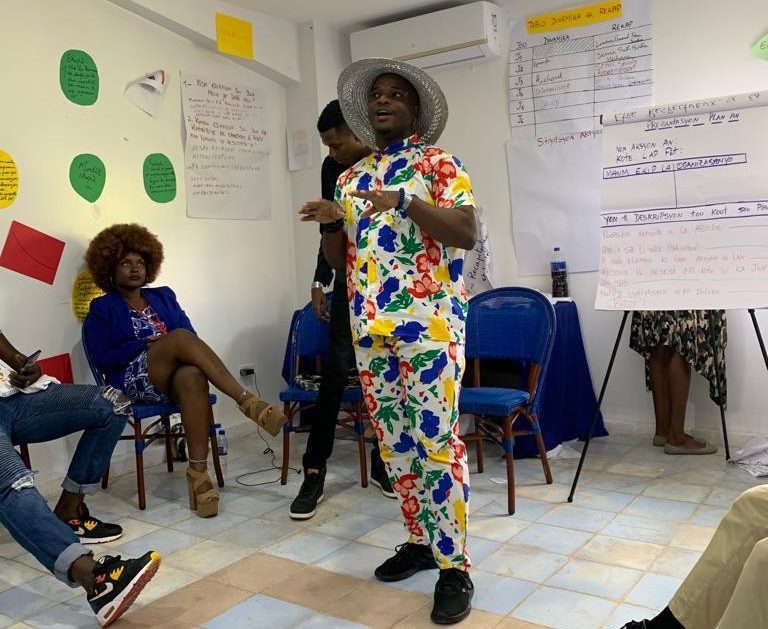
Rodneyson Bernardin: As an activist, I was fortunate enough to be noticed by the Kouraj Association, which invited me to a 4-day training seminar on entrepreneurship within the LGBT+ community in Haiti. It was organized in December 2021, co-facilitated with the Inter-American Foundation.
This training aimed to equip us with business creation skills relevant to the local economic context. The main topics covered were related to credit, receivables, the banking system, and different types of clients.
The development of micro-entrepreneurship and small businesses was a central focus; however, some participants had projects related to selling electronic equipment or construction materials.
I was subsequently able to benefit from a loan of 25,000 gourdes to be repaid to Kouraj six months after the initial disbursement. (Editor’s note: 25,000 gourdes is approximately $190 USD, or two months of the median income in Haiti.)
The financing plan to support the development of my business should have included a second payment of between 50,000 and 75,000 gourdes, after the first repayment. Unfortunately, despite meeting my loan repayment deadlines, I did not receive these amounts, which I was counting on heavily, as everything had been contractually agreed upon between the association and me.

Business development and assessment
Erasing 76 Crimes: Have you found a warehouse and been able to procure inventory?
Rodneyson Bernardin: I relied exclusively on social media to reach customers within the LGBT+ community. That’s why I used the WhatsApp messaging app.
To be perfectly realistic, with 25,000 gourdes, I couldn’t buy large quantities, so having a warehouse wasn’t necessary.
With the loan, I was able to buy, for example, six large bags of rice, two large bags of black beans, corn, and butter, which customers could pick up from my home. However, this only lasted 10 months, and although sales were very low some days, I was still able to repay the loan, which proves that my business was viable.
Ultimately, I learned how to manage a small business, developing strategies to acquire new customers while generating a small profit margin.
However, without a partner or new lines of financing available, my business gradually dwindled. Overall, I wish I had received more support throughout my project.
In hindsight, the main obstacle I encountered was the small amount of initial investment capital. As a micro-entrepreneur, I was limited in my choices and my ability to invest. I could buy 5 bags of rice when I should have needed 10, because my business was designed to handle higher volumes. This was a source of frustration.
However, I appreciated the sense of independence this project gave me, working with clients from a social background I know intimately. I found meaning, my place, and a possible future there. For me, it was a true school of life.

