

Ukraine LGBTQ people notch wins in court, setbacks in parliament


As attitudes on LGBTQ rights shift in Ukraine, politicians are slow to make progress

The online publication New Voice of Ukraine reported:
The human rights group Nash Svit LGBT Human Rights Center published a report on July 17 on the social, legal and political situation of LGBTQ people in Ukraine during the first half of 2026, noting improvements alongside continued rights violations based on sexual orientation and gender identity.
The center assessed the situation across several areas: legislation and the courts, the stance of state and law enforcement bodies, the armed forces, local government, politics and media, the attitudes of churches and religious organizations, LGBTQ community activity, and instances of violence, discrimination and other rights violations.
According to the report, no significant changes have occurred in legislation related to LGBTQ rights protections in Ukraine since the start of 2026.
The report highlights particular concern over a draft new Civil Code of Ukraine, submitted to the Verkhovna Rada by a group of lawmakers led by parliament Speaker Ruslan Stefanchuk, which has not yet been adopted. The proposal has drawn criticism from civil society broadly and the LGBTQ movement specifically over its new definition of “family member,” which would exclude same-sex partners — contrary to the current Family Code, which effectively recognizes family relationships between same-sex couples.
“Since more than 20,000 proposed amendments were submitted to Bill 15150, its vote in the second reading is expected no earlier than autumn 2026 or even later,” the report said.
If passed, the new Civil Code would effectively block another bill that would have amended the existing Civil Code to establish civil partnerships for same-sex couples. That bill stalled in parliament despite receiving Zelenskyy’s early support.
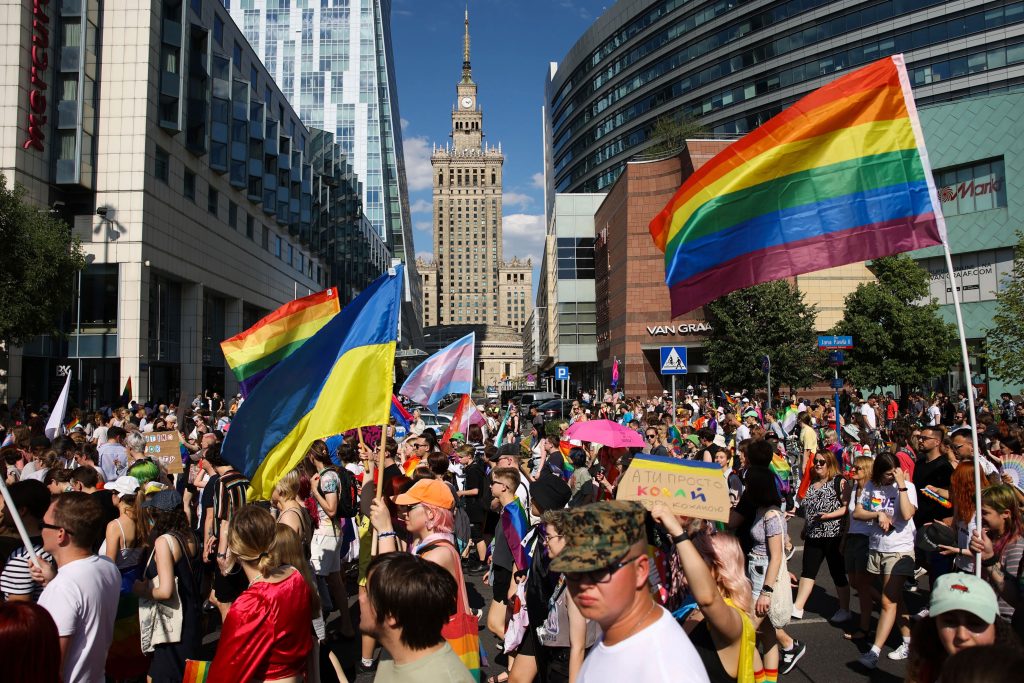
On public visibility, the report noted successful Pride Month events in Kyiv, Odesa, Kharkiv, Lviv, Lutsk, Dnipro, Vinnytsia, Uzhhorod, and other cities. The Equality March in Kyiv on June 21 drew about 5,000 participants, making it the largest in recent years. The report noted that the government and the president made several public statements supporting equal rights for LGBTQ people, but said passage of needed legislation remains stalled in parliament due to conservative lawmakers and behind-the-scenes lobbying by ultraconservative Ukrainian churches.
“The organizers of KyivPride reported on constructive cooperation with the city administration and police in holding and protecting pride events; there was also a noticeable improvement in cooperation with local authorities and police in holding LGBTQ events in Odesa and Lviv,” the report said. “The member of Verkhovna Rada Yevhen Petrunyak reported that he had sent a parliamentary appeal to the Mayor of Lviv proposing to ban LvivPride. However, he received a response ‘with references to the Constitution, the European Convention on Human Rights, the Law on the Legal Regime of Martial Law, and the Code of Administrative Procedure’ that the Lviv City Council only ‘offered the organizers alternative formats’ for holding the event, but did not apply to the court to ban it when they refused, and instead turned to the police with a request to ensure public order during the rally. As in Kyiv, the National Police provided reliable protection for pride events in Lviv from their aggressive opponents.”
Regarding church and religious community attitudes toward LGBTQ people, the report found that in recent years, Ukraine’s leading churches have tended to avoid public statements on LGBTQ issues while maintaining ultraconservative views and lobbying privately against any government steps to protect LGBTQ rights.

The report identifies religious activist and journalist Ruslan Kukharchuk, a Pentecostal who leads the ultraconservative All Together! movement he founded, as the most prominent and active religious opponent of Ukraine’s LGBTQ movement. The report describes the movement’s core aim as resisting the liberalization and modernization of Ukrainian society broadly, and opposing LGBTQ rights protections specifically.
The report also cited survey data on Ukrainian attitudes broken down by religious affiliation among believers. Despite strongly negative attitudes among the leadership of Ukraine’s major churches, ordinary believers showed more tolerant views, according to the survey. Support for banning discrimination against LGBTQ people stood at 81% among Christians unaffiliated with any church, 78% among Orthodox Church of Ukraine (OCU) believers, 72% among Ukrainian Orthodox Church-Moscow Patriarchate (UOC-MP) believers, 71% among Greek Catholics and 44% among Protestants. Support for legalizing registered partnerships for same-sex couples stood at 63% among non-denominational Christians, 56% among OCU believers, 44% among UOC-MP believers, 46% among Greek Catholics and just 25% among Protestants. Even support for same-sex adoption rights reached 54% among non-denominational Christians, 47% among OCU believers, 41% among UOC-MP believers and 37% among Greek Catholics, but only 17% among Protestants.
“It can be stated that believers of Ukraine’s largest denominations (Orthodox and, to a lesser extent, Greek Catholics) in their attitude towards the recognition and protection of LGBTQ people’s rights demonstrate views typical for Ukrainian society as a whole,” the report’s authors concluded. “Only Protestants — which in Ukrainian realities means the so-called Evangelical Christians (Baptists, Adventists, Pentecostals) — demonstrate a much more conservative and unfriendly attitude.”
Regarding violence and discrimination, Nash Svit’s monitoring network documented 26 cases of homophobia or transphobia between January and June 2026. Using OSCE classification criteria, six of these were characterized as hate crimes and five as hate incidents, with one incident also involving hate speech.
The report was issued a few weeks after Ukraine President Volodymyr Zelenskyy spoke positively about LGBTQ rights.

