

Cameroon Legal Café empowers participants to know their rights


SOS Solidarity teaches Cameroonians how to access justice after arbitrary arrests
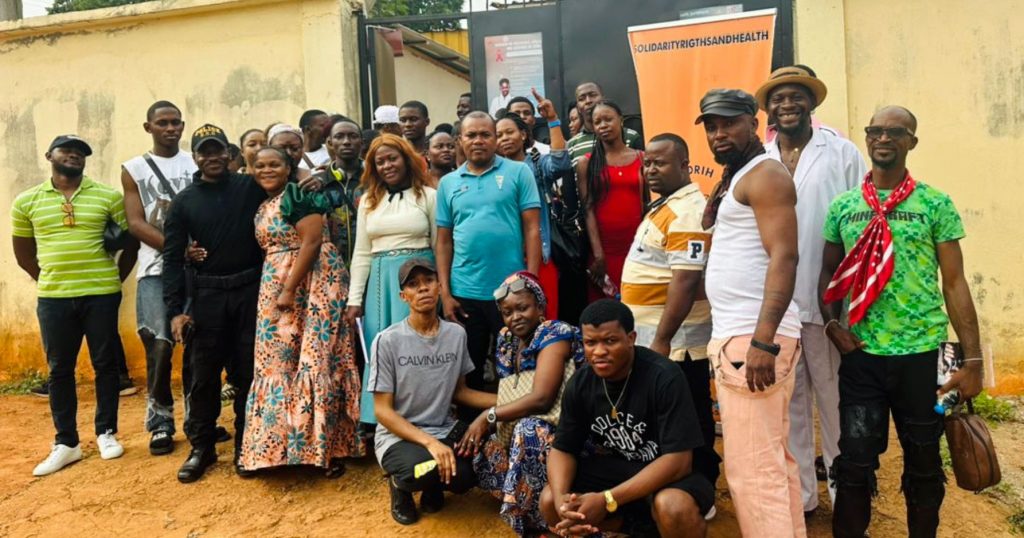
In a friendly yet studious atmosphere, about fifty participants gathered at the small market in the Odza neighborhood of Yaoundé on January 30 for the monthly Legal Café organized by SOS Solidarity Rights and Health (SORIH). The January session focused on “Access to Justice for Vulnerable Populations in Cameroon: The Case of Arbitrary Arrests.”
The Legal Café was created with the aim of bringing the law closer to citizens, especially the most vulnerable. Far from university lecture halls or official conference rooms, these meetings are held in popular, accessible locations where everyone can ask questions and share their experiences.
The executive director of SORIH opened the session with a welcome address, followed by introductions of the participants. The activity was facilitated by a judicial police officer, ensuring an exchange that was both educational and grounded in legal practice.
This edition brought together a variety of stakeholders:
- Key populations, including LGBTQ people and sex workers, who are regularly victims of arbitrary arrests
- Survivors of violence, who came to testify and share their experiences
- Civil servants, who are committed to defending human rights
- Legal and paralegal professionals from the Global Fund project, providing their technical expertise
- The general public, eager to better understand their rights and available legal recourse
This plurality of voices gave the debate a unique richness, blending personal accounts, legal analyses, and citizen proposals.
The discussing began by defining what an arbitrary arrest is. That’s when someone is detained without valid reason, without legal procedure, or without respect for fundamental rights. An unlawful arrest is when the authorities (police, gendarmerie, etc.) arrest a person in violation of their rights.
The second part of the discussion focused on how to behave in the event of an unlawful arrest. Participants’ recommendations converged on maintaining a calm and cooperative attitude to avoid escalation:
- Remain calm and cooperate.
- Ask for the reasons for the arrest and remind them of their rights.
- Contact a lawyer or a relative immediately.
Phones and image rights: freedoms under threat
Two sensitive topics were then addressed: searching mobile phones and image rights during arrests.
Participants reiterated that phones are personal devices and that no police officer has the right to search them without serious grounds, except in cases of flagrant offense.

As for the right to one’s image, it is protected by Cameroon law. Disseminating a photo or video of an arrested person without their consent constitutes an invasion of privacy, punishable by civil and criminal penalties.
After two hours of discussions, one conviction emerged: access to justice for vulnerable populations remains a major challenge in Cameroon. Arbitrary arrests constitute a flagrant violation of human rights and call for profound reforms.
Community awareness-raising, training for law enforcement, and collaboration between civil society and judicial actors appear to be essential levers for guaranteeing dignity and justice for all.
The Legal Café, through its participatory and grassroots format, is an essential tool for raising awareness and defending rights—especially since it directly engages key populations, survivors of violence, civil society actors, lawyers and paralegals from the Global Fund project, as well as the Cameroonian public.

