

After U.S. cuts anti-HIV funds, Kenya’s health staff work without pay


Kenya’s plight shows partial impact of America’s widespread foreign aid cuts
The Devex development news service reported the story:
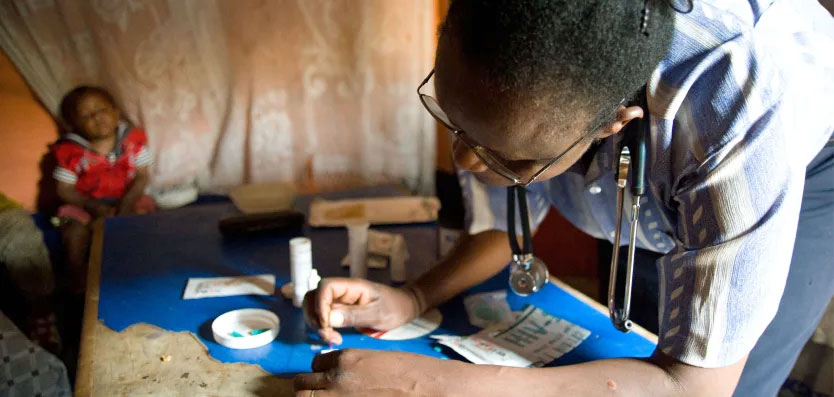
‘I can’t just leave them’: Kenya’s health workers carry on without pay
By Victoria Amunga
KISUMU, Kenya — On a hot Tuesday afternoon, 52-year-old Paul Ochieng sits in a consultation room at Ogongosa health center on the outskirts of Kenya’s Kisumu city. He is not there for his own appointment; he has accompanied one of his teenage clients after completing morning home visits.
But unlike years past, Ochieng will return home without pay for the day’s work.
For nearly 20 years, Ochieng has walked the narrow footpaths of Konyango village, stopping at homes where HIV-positive youth wait for their morning check-ins. He has been their first point of care, reminding them to take their antiretroviral pills, bringing nutritional support, and offering quiet counselling during his daily rounds.
Ochieng most recently delivered care under a USAID-funded PEPFAR program for orphans and vulnerable children, but early this year, abrupt and sweeping U.S. foreign assistance cuts left community health workers — and the children they serve — in limbo. He has received sporadic, unpredictable payments from the government, far less than the regular stipend he relied on under PEPFAR, otherwise known as the U.S. President’s Emergency Plan for AIDS Relief. Still, Ochieng heads out each morning to stay connected to the 50 children assigned to him under the now-defunct program, determined not to let the disruption sever the relationships he has built.
Some of his colleagues have had to stop their work in order to look for other, more stable paid opportunities. Stepping in to cover for them is overwhelming, Ochieng said, but the children rely on him in ways others may not see: “We are the ones who know them, we follow up so that they don’t stop taking their medicine. Some of them are orphans, so I have to follow up with them because they still depend on me.”
The aid cuts forced many programs like the HIV prevention program Ochieng worked for to scale back or close. Outreach supplies dwindled, and even basic paper stationery became scarce. Yet the needs of the younger clients are impossible to ignore. The work has become increasingly unsustainable, but Ochieng continues, knowing he is the only link now between his HIV-positive patients and professional care.
“I don’t want them to be worried, I can’t just leave them,” he said. “They would come to me if they had any problems. They depended on me like their parents, that’s why I stayed.”
U.S. foreign assistance has played an outsized role in financing Kenya’s health services. The U.S. Agency for International Development committed approximately $470 million in foreign aid to Kenya annually between 2020 and 2025, with 80% of the funds allocated for health-related programs. Research from Physicians for Human Rights shows that abrupt U.S. foreign aid cuts have had direct, severe consequences for Kenya’s health sector, forcing the suspension of HIV prevention and monitoring services, closing clinics, and leaving many of the estimated 41,500 health workers — roughly 18% of the country’s health workforce — without reliable funding or employment.
In early December, the U.S. and Kenya signed a new bilateral health agreement intended to restructure health financing and transition more responsibility to the Kenyan government, though a Kenyan court has since suspended parts of the deal over data privacy concerns. In the meantime, many health workers continue to go unpaid.
”We’ve heard from health care workers working in severely constrained circumstances, with fewer health care workers for many more patients due to reductions on health care workforce that had to come from the funding cuts,” Thomas McHale, director of public health at Physicians for Human Rights, told The Aid Report.
‘Life has become very difficult’
Approximately 60 miles north of Kisumu, in Kenya’s Bungoma County, former community health worker Grace Nekesa, 26, is trying to adjust to her own new life after a USAID-funded mental health wellness program called MiCARE closed. Through implementing partner LVCT Health, Nekesa used to spend her time training local youth on mental health and strategies to prevent HIV and sexually transmitted infections.
Nekesa lost her job in April with the closure of the program, thrusting her into a period of uncertainty and isolation, with mounting financial strain. She is still searching for work.
“Life has become very difficult,” she said. “Sometimes I have problems, but I have nobody to talk to because the community saw us as their pillar, and now I can’t go back to cry to them,” she said.
Impacts of global health funding cuts vary by region, but the regions of Nairobi, Kisumu, Kilifi, Kiambu, and Uasin Gishu have been among the hardest hit, according to Physicians for Human Rights. Programs supporting survivors of sexual violence and HIV services have been particularly affected, with many facilities reporting high rates of antiretroviral stockouts. Local governments are now scrambling to identify alternative sources of funding to keep services running.
”I see governments and counties working to provide these programs. In many cases, the U.S. government was providing massive — over 70% — of the response for some of these health care inputs and programs. It really is a question of finding the financing and to continue these programs,” said McHale.
Community health workers are crucial for preventive care and disease tracking, offering a level of patient attention that clinics cannot match. As members of the very communities in which they serve, they bridge the gap between formal health services and people who might otherwise go without care. While community health workers are not formal doctors or nurses, they identify serious health cases that need urgent attention, provide guidance on hygiene and nutrition, and raise awareness on critical health issues. Their disappearance, experts warn, is a catastrophe in the making.

”If there are no community health workers to connect people to the clinic, then they won’t be able to get the resources,” McHale told The Aid Report. “And if there aren’t outreach services to even connect people in the households and in the rural communities and informal settlements and other areas, there [is] a real worry that many people … won’t be able to make those connections to care.”
The loss of community-level support is already being felt by people such as Emmanuel Barasa, a psychologist who had been enrolled in a USAID-supported mental health outreach program that also employed health worker Grace Nekesa. Barasa said the therapy sessions were a lifeline during periods of burnout.
”Me being a health care worker, I have been receiving this particular service when I have burn[t] out, and currently am not receiving them … and remember we have shortage of staff in various departments, now the burnout continues,” Barasa said.
A partial response to a widening gap
To help fill the donor gap, the Kenyan government issued a directive in September 2025 to absorb community health workers into county payrolls. State officials say the Ministry of Health has allocated stipends for community health promoters, also known as community health workers.
”We are leveraging on the community health strategy to equip our community health promoters to provide essential services of reaching the affected community members with the essential medication,” said Wyckliff Omondi, an assistant director at the Ministry of Health. Previously, many of these interventions depended on donations, he explained, but the goal now is to make service delivery more consistent.
Under the policy, the national government provides a monthly stipend of KSh 2,500, which county governments are expected to match with an additional KSh 2,500, for a total of KSh 5,000 ($31) per worker per month, Omondi said.
Lilian Aoko, a community health worker in Nairobi’s informal settlement of Kibera, told The Aid Report that she received KSh 3,500 following the directive, but payments have since become irregular or stopped altogether. By contrast, she said, USAID-funded programs previously provided about KSh 7,000 per month.
That’s why for many, plugging the donor gap remains unlikely. Dorcas Nyambura, a program officer with Physicians for Human Rights, said state and county governments fall far short of the recommended 30% health budget allocation — with many counties in Kenya allocating just above 10%.
”Realistically, I don’t think it’s possible, first of all, given the challenges that the county governments are already facing [in] financing the existing persons on their payroll,” Nyambura said. “We’ve seen doctors go on strike a number of times.”
In Kisumu, Ochieng continues to accompany his young clients to clinics and make home visits across Konyango village, even as the funding that once supported his work has been stripped away. The programs that trained and paid him remain shuttered, and government stopgap measures have yet to provide a reliable income. For now, continuity of care for dozens of HIV-positive children depends largely on workers like him, who still show up despite growing uncertainty over how long that will be feasible.


As the world decries The US action withdrawing her funding support from most health areas, here in Kenya in the Ministry of Repentance and Holiness we are celebrating Millicent Awino who travelled to South Africa for HIV testing, and the results are in: she’s HIV negative with zero copies of the virus detected this is a wonder.
The Eternal Blood of Jesus Christ deleted HIV from her body, and she is HIV negative. So run to Jesus stop relying on man, you are cursed if you depend on man.