

Queer Cameroonians speak out about desire to become parents


New Cameroonian study documents social, legal, and financial obstacles to queer parenthood
By Steeves Winner
In Cameroon, having a child is perceived as a social obligation, a condition of acceptance and respectability. But for queer people, this universal desire encounters legal, medical, and community obstacles. A new study conducted by Femmes Debout Research and Documentation Center (CRD) documents these invisible realities and maintains that starting a family is also an act of resistance.
The Femmes Debout Research and Documentation Center is an organization based in Yaoundé, Cameroon, led and primarily composed of trans people, that works to combat violence against minorities, particularly trans people, and positions itself as a space for identity, research, and advocacy.
A Universal Need, a Particular Pressure
A recent CRD survey of 41 LGBTI Cameroonian people revealed that all express a desire for offspring, but social and familial pressures weigh heavily on them. CRD unveiled its report on that survey last month. The report included the following survey responses and findings:
“The desire for children is linked to social recognition,” confides a 29-year-old trans woman.
A trans man adds: “In support groups, I understood that my desire for children was not a weakness but a strength.”
Age and Social Pressure
The peak age for wanting children is between 26 and 30. This period corresponds to the age of majority and family expectations.
A 22-year-old trans student testifies: “Thanks to the support program, I was able to speak freely about my desire for children, even though I don’t yet have the financial means.”
A 27-year-old lesbian explains: “The workshops helped me see that I’m not alone in having this dream.”
Strategies and Methods Considered
Faced with obstacles, queer people develop various strategies: home insemination, targeted sex, and cover relationships.
One participant recounts: “I learned about the risks of home insemination during the community sessions. This allowed me to consider other, safer options.”
A queer woman married for convenience confides: “The listening center gave me the strength to say that this marriage wasn’t my choice, but a strategy.”
Legal Obstacles and Exclusions
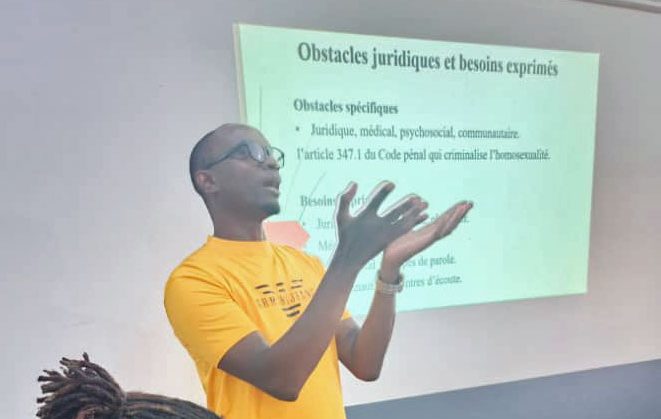
Law 2022/014 on Assisted Reproductive Technology (ART) explicitly excludes queer couples. The costs of medical techniques (CFA 1.5–3 million, approximately $2700-5400 USD) are prohibitive.
A trans man testifies: “When I discovered that the law rejected me, I felt a great deal of anger. But the project showed me that collective advocacy could change things.”
Non-Biological Options and Support
Some people are exploring adoption, co-parenting, or blended families.
A 40-year-old single lesbian recounts: “I was able to file an adoption application thanks to the legal advice I received through the project.”

A queer couple adds: “Community mediation helped us clarify our responsibilities as co-parents.”
Expressed Needs and Lived Experiences
Respondents identified several priorities: legal advocacy, inclusive healthcare networks, and support groups.
One participant summarized: “The support groups saved me. I was finally able to say I wanted a child without shame.”
A trans woman concluded: “The listening center became my family. We learn there that our desire for a child is legitimate.”
Mobilizing Conclusion
CRD concluded that the need to have children is human, legitimate, and universal. For queer people in Cameroon, it also becomes an act of resistance and belonging.
The slogan “One child, one right, one dignity” encapsulates the issue: recognizing that the desire for parenthood cannot be confiscated by the law or by social norms.
Community projects demonstrate that support, listening, and solidarity are powerful tools for transforming pain into hope.
Steeves Winner, the author of this article, is a Cameroonian journalist who writes under a pseudonym. Contact him at steeves.w@yahoo.com.

