

2025 LGBTQ rights update: Anti-trans hysteria mars Europe’s LGBTQ gains


One of a series of updates about LGBTQ rights internationally, region by region
LGBTQ rights journalist Rob Salerno, an editor for Erasing 76 Crimes, surveys the status of LGBTQ rights and marriage equality in this series. (Click here to subscribe to his LGBTQ Global newsletter.)
UK and Sweden went nuts on anti-trans hysteria, but several other bright spots emerged
European Union: One of the biggest developments in Europe was the Court of Justice of the EU ruling in November that all EU member states must recognize the same-sex marriages that are formed by EU citizens who are legally resident in other EU member states. The ruling specifically says member states are not obligated to legalize same-sex marriage in domestic law, and it appears that transcribing the marriage as a civil union will satisfy the ruling, if domestic law allows that, but only if the couple maintains all the rights of marriage. The case stemmed from Poland, where the Polish constitutional court asked for the CJEU’s advice. So far, it’s not clear how Poland is going to implement the ruling, nor the other EU states that don’t recognize same-sex unions: Bulgaria, Slovakia, and Romania.
The case will also hold repercussions for all the prospective members hoping to join the EU: Ukraine, Moldova, Georgia, Bosnia-Herzegovina, Serbia, Montenegro, Albania, Kosovo, North Macedonia, and Turkiye. Of these, only Montenegro recognizes same-sex unions.
Activists also collected more than 1,000,000 signatures to force debate on an initiative to ban conversion therapy EU-wide. The EU Commission is now working on promoting bans at the national level, but I don’t think it’s likely we’ll see EU legislation on it.
On the EU integration front, Bulgaria was set to join the eurozone on Jan 1, 2026, while negotiations for Montenegro and Albania’s accession are proceeding apace, with a target 2028 accession date.
 |
Central Europe
Austria and Switzerland: Both countries’ parliaments failed to make any progress on passing a conversion therapy ban, which has long been promised and debated in both.
Switzerland: The government announced plans to bring forward legislation to open assisted reproduction to unmarried people.
Liechtenstein: The same-sex marriage law passed in 2024 came into effect on Jan. 1, 2025.
Czechia: The enhanced same-sex partnership bill that passed in 2024 came into effect on Jan. 1, 2025. Partnerships are now equal to marriage in all fields, except joint adoption is not allowed. (Step-child adoption was legalized, though).
Complying with a 2024 court order, the ministry of health ended the requirement for trans people to be sterilized/undergo surgery before changing their legal gender.
Parliamentary elections in October netted a government with a mixed record on LGBTQ rights – and a creepy affinity for Russia. It doesn’t appear likely that a redo of the 2024 marriage equality vote in this parliament will yield victory.
Slovakia: The government amended the constitution to recognize only two genders and bar legal gender change, and to bar unmarried couples from adopting – effectively barring same-sex couples and singles from adoption.
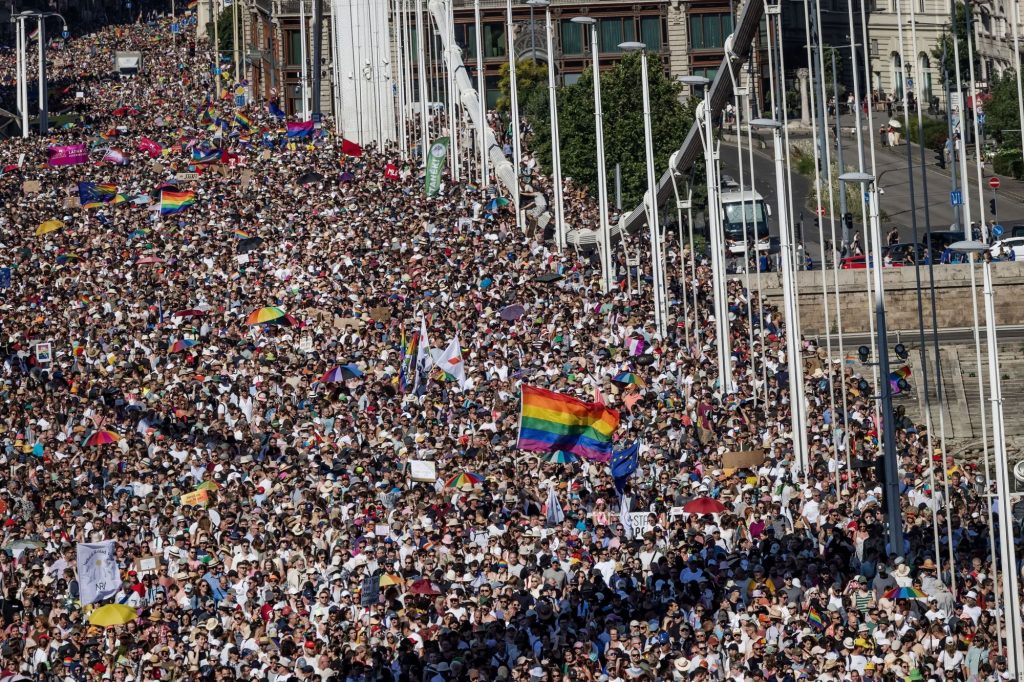
Hungary: The government continued its campaign against LGBTQ people, but it appears to be reaching diminishing returns, or even backfiring.
A constitutional amendment was passed banning public demonstrations for LGBTQ rights, in an attempt to ban the annual Budapest Pride parade. Instead the event turned into one of the largest anti-government protests yet – and brought denunciations and funding freezes from across Europe.
Hungary’s staunchly anti-LGBTQ government is facing elections in May, and for the first time is trailing behind the opposition in the polls. While I wouldn’t expect a new government to do a complete 180 on LGBTQ rights, we have to assume that a new PM would be better.
Poland: The country has been stuck in a holding pattern on LGBTQ rights since the 2023 election of PM Donald Tusk and his centrist coalition, which only got worse in May when a far-right, anti-LGBTQ candidate won the presidency.
A long-promised bill to enact civil unions has been continuously watered down under threats of blockage by the junior coalition partner or the president. It’s now being called “closest person status,” which is some word salad, and the president is still threatening a veto.
The ECJ handed down a pair of judgements against Poland – the abovementioned requirement to recognize foreign EU marriages, and a second one rapping Poland’s knuckles for refusing to grant certificates of no impediment to Polish citizens who wish to enter same-sex marriages abroad.
In March, the supreme court issued a ruling simplifying the process for legal gender change – it no longer is considered a court trial, and now the only person who may intervene is the person’s spouse (previously, a trans person would have to sue their parents for the right to transition).
And the last municipality to still have an “LGBT-free zone” ordinance passed under the previous administration finally repealed it.
Eastern Europe
Armenia: As Armenia continues its drift out of Russia’s orbit and closer to the West, in December, Armenia signed a strategic agenda that calls on the country to combat anti-LGBT discrimination. It’s not much, but the country is starting from basically rock bottom.
Georgia: Anti-government protests continued throughout the year following disputed elections in 2024, and they don’t show signs of stopping. Alas, neither does the demagogic, anti-LGBT government. Georgia’s government has officially frozen its EU accession ambitions.
Moldova: The Pro-EU government won parliamentary and presidential elections this year, cementing the country’s westward lean. The conditions in the country and in the neighboring war in Ukraine have led the government to more aggressively pursue reconciliation with the unrecognized breakaway Republic of Transnistria – if reincorporated, not only would it remove a locus of Russian influence, the progress on LGBT rights that Moldova has made in recent years would flow to the reincorporated territory.
Russia: Russia continued its crackdown on LGBTQ people, clubs, and organizations under its so-called “propaganda” laws. In December, a court in North Ossetia ordered a gay man into conversion therapy for sending nudes.
Ukraine: The top-line issue has been the war to dislodge Russian invaders, which has been grinding on for nearly four years. Against this backdrop, there hasn’t been much progress on LGBTQ issues, and a civil partnership bill appears stalled.
One bright spot was that a court for the first time recognized a same-sex couple as a family. The limited ruling focused on a couple that was denied family rights when one partner was appointed in the diplomatic service to another country.
That said, the government did take steps on its path toward EU membership, passing a roadmap for integration into the union. Part of that called for the government to pass some form of civil union law by the end of 2025 – obviously that didn’t happen – and to adopt a law on anti-LGBT hate crimes and hate speech in 2026. It’s also begun consultations on an anti-discrimination law. Keep an eye out for these.
EU leadership is keen to bring Ukraine into the union as a show of solidarity, but a handful of pro-Russian countries (Hungary and Slovakia, mostly) have been blocking progress on the negotiation process.
Ukraine also joined the International Criminal Court this year. But in a (sadly, understandable) blow to disarmament efforts, Ukraine announced its intention to withdraw from the Ottawa Treaty banning land mines, though it hasn’t done so yet. Latvia, Lithuania, Estonia, Poland and Finland, all bordering Russia, also withdrew from the treaty. Lithuania also withdrew from the Cluster Munitions Convention – none of the other states were members of it.
Northern Europe
Lithuania: The constitutional court ruled that the lack of recognition of same-sex couples violated the constitution and ordered the government to pass a for civil unios. The government has thus far been unable or unwilling to pass a bill, but the courts have allowed unions to be registered anyway, much as happened in neighboring Latvia. Toward the end of the year, a cross-party group of lawmakers introduced a civil union bill, but it’s unclear if it has support to proceed.
Latvia: Parliament voted to withdraw from the Istanbul Convention on Domestic Violence over trumped-up fears that it imposes same-sex marriage and trans rights on countries. The President declined to sign the withdrawal bill, so the process is likely on hold until after elections in October.
Iceland: The government ended its ban on blood donations from men who have sex with men in July.
Sweden: A package of laws that restrict gender care for minors that was passed in 2024 came into effect in July.
Southern Europe
Greece: After backlash from some conservatives over the legalization of same-sex marriage and adoption in 2024, the government rushed out a bill that will ban gay men from accessing surrogacy. It has not passed yet.
Also this year, the supreme court upheld the legality of the same-sex marriage law, and the government announced plans to update inheritance laws to recognize same-sex couples. The courts also take away – a lower court has reversed the government’s policy ending a ban on gay blood donation, saying it lacked scientific evidence.
Cyprus: My prediction in 2024 that Cyprus would soon follow Greece to legalizing same-sex marriage has not come true, and it doesn’t even appear on the horizon.
The government sent a new sexual harassment policy to schools, including a ban on anti-LGBT discrimination.
The most positive development on the island is that the breakaway Turkish Republic of North Cyprus ousted its hardliner president and elected a pro-union successor, which may see reunification talks restart in the new year. If the TRNC were to rejoin Cyprus, and thus the EU, a host of LGBTQ rights legislation would newly apply to the territory. So far, Turkiye remains staunchly opposed to reunification, but the Cyprus government is hoping to use its turn at the EU presidency beginning in January to offer Turkiye a host of concessions in order to bring it on board with peace talks and even with allowing Cyprus to eventually join NATO.
Turkiye: Meanwhile, the Turkish government continued its slide toward Islamism and autocracy with a suite of proposed legislation that would intensify an ongoing crackdown on LGBTQ people. The “11th Judicial Package” includes provisions that criminalize “behaviors and attitudes contrary to biological sex and general morality,” places onerous restrictions on gender care with criminal penalties for violation, bans LGBTQ-positive expression, and criminalize anyone taking part in a same-sex marriage. The proposals have drawn sharp criticism from civil society and the European community.
Italy: While the government is no friend to the LGBT community, the courts have stepped up a little this year to protect LGBT rights with four key rulings: one found that a same-sex couple that conceives overseas with IVF has the right to have both partners listed on a birth certificate; another struck down a ban on adoption by unmarried individuals (including, de facto, LGBT individuals); another requires that government documents for children of same-sex parents use gender neutral terms; finally, the court found that the nonbiological mother in a same-sex couple is entitled to mandatory paternity leave.
Italy won’t hold national elections until 2027.

Spain: Congress voted to stiffen penalties against conversion therapy – it now carries criminal, rather than just administrative penalties.
The Castille and Leon region and Asturias region began processing bills banning anti-LGBT discrimination, though both appeared mired in gridlock. They are the only two regions that have never had such laws, although the far-right coalition in Madrid repealed that region’s law in 2024.
Andorra: The country signed, but has not yet ratified, the International Covenant on Economic, Social and Cultural Rights.
Albania: The country acceded to the Optional Protocol to the International Covenant on Economic, Social and Cultural Rights, which establishes an individual complaints mechanism.
Montenegro: The government was working on a gender identity law and a nondiscrimination law, but neither has advanced. Presumably, both are part of a push to bring its laws in line with the European mainstream as part of its EU accession bid (although neither is strictly required, from what I can tell).
Romania: The government has proposed a hate crime law that would enhance sentences for crimes motivated by sexual orientation, gender identity, or HIV status, among other characteristics.
Western Europe
UK: The biggest development was the UK Supreme Court’s shock decision in April that trans women do not count as women for the purposes of equality/nondiscrimination law. This has lead to an even greater backlash against trans rights in the country, as trans women are being progressively excluded from more places in supposed compliance with the ruling. Just this month, the Girl Guides UK announced they would no longer accept trans girls into the program.
PM Kier Starmer’s disappointing Labour government is in its second year of not delivering conversion therapy ban legislation, although the government insists its coming in the new year. Sure.
The government also introduced stiffer penalties for anti-LGBT hate crimes as part of a controversial crime and policing bill, which is still before the house of lords.
The UK also unveiled a memorial to queer soldiers who were discharged under old anti-LGBT laws.
The UK territory Gibraltar did introduce a conversion therapy bill in November.
The Isle of Man passed a bill granting same-sex parents legal equality compared to heterosexual parents, while Jersey passed a law abolishing the legal concept of “legitimacy” regarding children and allowed same-sex parents to both be listed on their child’s birth certificate.
Ireland: The government once again failed to bring forward conversion therapy ban legislation as promised, but it did bring forward a new LGBTI-inclusive school curriculum for schools.
The high court ruled in favor of a same-sex couple whose child born abroad had been denied citizenship, ordering the government to close the gap in legislation that allowed the denial.
Netherlands: The lower house of parliament passed a bill banning conversion therapy – it’s now awaiting a final vote in the senate.
In October, Dutch voters elected Rob Jetten as the country’s first openly gay (presumptive) prime minister – although talks are still ongoing to form his coalition government.
Luxembourg: The country passed a major reform to its adoption laws, clarifying that same-sex couples and singles can adopt, but didn’t set up automatic parenting recognition for same-sex parents.
The government did announce an action plan for LGBTQ rights, which should begin to see action in 2026, and which will include automatic parenting recognition, banning conversion therapy, banning surgeries on intersex children, ending the gay blood ban, and recognizing nonbinary genders.
Monaco: Prince Albert II vetoed an abortion decriminalization bill that had been passed through parliament in an 18-2 vote. Albert stipulated his refusal is because of the principality’s officially Catholic nature. That likely signals how a push for same-sex marriage is going to go, even as a case is pending before the European Court of Human Rights appealing the local courts’ decision not to recognize foreign same-sex marriages.
At least one legislator is talking about bringing forward legislation to recognize same-sex parents in law.

